
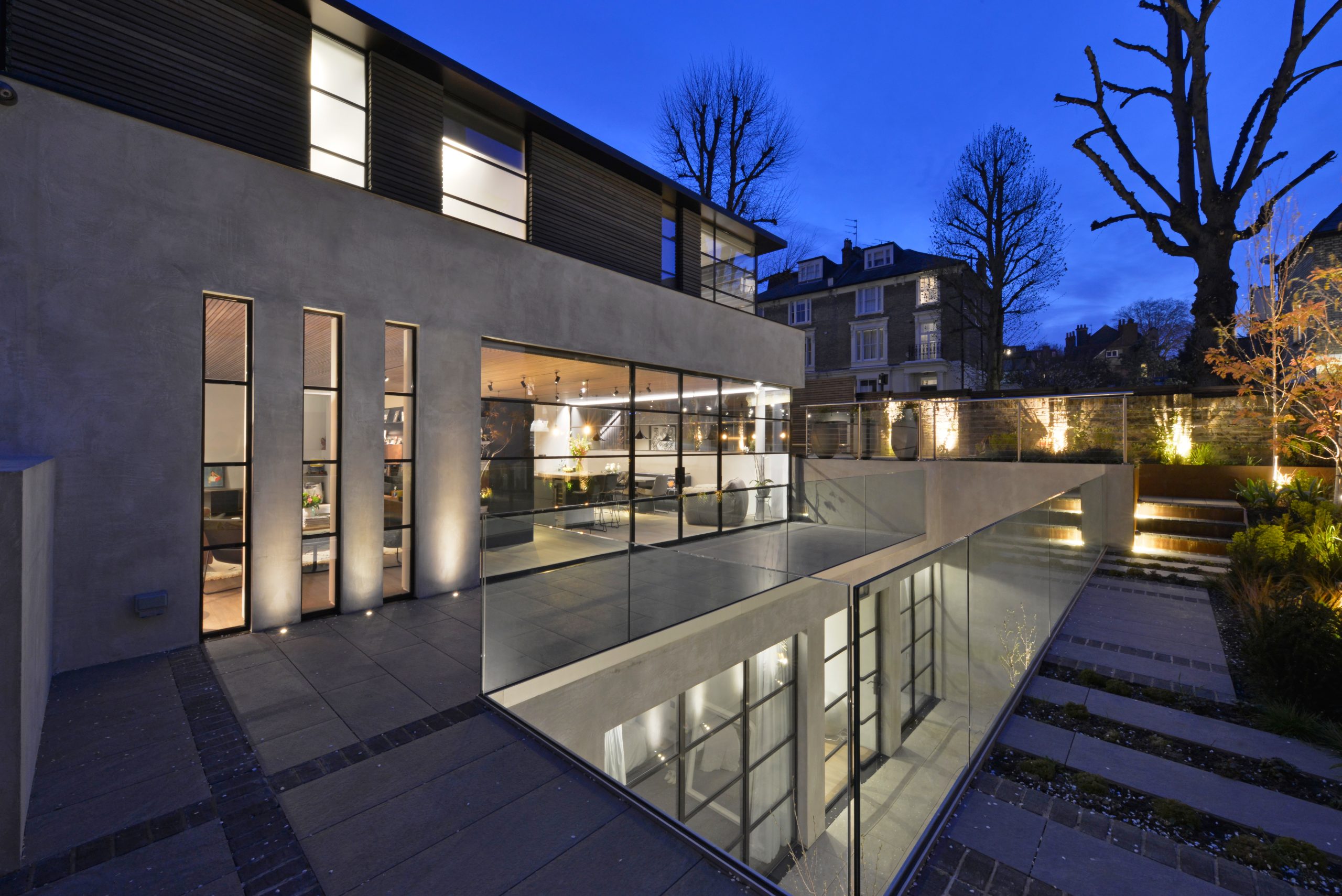
Windows for Passive House New Construction
Passive House new construction demands triple-pane assemblies with center-of-glass Ug as low as 0.40 W/m²K, whole-window U-values as low as 0.14–0.18 Btu/h·ft²·°F, and thermally broken frames verified at the component level. LuxHaus sources high-performance windows from Germany, Italy, and Poland — triple EPDM seals, warm-edge spacers, and 400+ glazing configurations — engineered to meet PHIUS climate-specific load targets as a unified thermal assembly.
Why Windows Passive House New Construction Gets Right — or Wrong — Everything
The fenestration envelope is the single most consequential set of decisions in a Passive House project. Choose the wrong system and no amount of mechanical refinement recovers the heat-loss budget. Choose correctly, and the thermal envelope performs as a unified whole, reducing peak loads enough to downsize or eliminate conventional HVAC. This article gives architects a working framework for specifying windows on Passive House new construction — from performance thresholds and frame typology to glazing configuration, installation detailing, and the coordination tasks that fall squarely on the design team.
What Passive House Demands From a Fenestration Assembly
Passive House is a load-reduction methodology, not a product certification. The standard — administered in North America by PHIUS, the Passive House Institute US — sets annual heating and cooling demand limits based on climate-specific modeling. Windows are evaluated as complete assemblies: frame, glazing unit, spacer, and installation interface all contribute to the modeled performance. A window spec that passes in Climate Zone 4 will often fall short in Zones 6 or 7, where the heating load targets are tighter and the penalty for a weak thermal break is immediate and measurable.
What this means practically: windows passive house new construction requires are not simply high-performance windows with a certificate. They are assemblies verified at the component and installation level, with thermal bridge coefficients fed into WUFI Passive or PHPP modeling software. The architect’s role is to specify systems whose certified data — or independently tested data — is model-ready.
Triple Glazing: The Baseline, Not the Premium
Why double glazing does not qualify for most Passive House new construction
In most North American climate zones above Zone 3, double-glazed assemblies — even high-quality ones — cannot satisfy the thermal demand limits PHIUS sets without compensating mechanical loads. Triple glazing, with two low-e coatings and appropriate gas fill, is the practical baseline for windows passive house new construction across Zones 4 through 8. The additional weight and cost are real; so is the payoff in peak-load reduction.
The glazing configuration matters beyond the number of panes. Soft-coat low-e positioning, gas fill selection (argon versus krypton), and spacer conductivity each affect the center-of-glass and edge-of-glass performance that drives modeled behavior. Premium glazing systems sourced from Germany, Italy, and Poland are optimized for exactly this configuration — triple-glazed units with warm-edge spacers and thermally broken aluminum or fiberglass spacer bars are standard production, not special order.
Frame performance is where most specifications fall short
The frame is typically 20–30% of the window area. In a Passive House assembly, a frame with a poor thermal break can undercut an otherwise excellent center-of-glass value significantly. Extruded PVC multi-chamber profiles and fiberglass pultrusion frames perform well. Thermally broken aluminum profiles from German-manufactured systems can also qualify — but the break geometry and filler material must be verified against PHIUS component data, not assumed. Timber-clad composite frames from Polish-manufactured systems offer a durable exterior with low conductance and are increasingly used in North American Passive House new construction.
Window Typology for Passive House Projects
Not every operable type is equally suited to airtight construction. The design team must weigh daylighting, ventilation logic, and airtightness together.
- Tilt-turn (inward opening): The dominant choice for windows passive house new construction. Perimeter compression seals on all four sides, tested airtightness in the range needed for Passive House, and dual-mode operation. German-made tilt-turn systems are widely used and carry component certification data for PHIUS modeling. A window consultant or product rep should supply psi-values and frame U-values in SI units suitable for WUFI or PHPP input.
- Fixed lites: The most thermally efficient option where ventilation is handled mechanically, which it typically is in Passive House — an HRV or ERV handles air exchange. Large fixed lites are an opportunity to capture solar gains on south-facing orientations, which PHPP rewards directly.
- Casements (outward opening): Italian-crafted casements with multi-point locking and continuous perimeter gaskets can qualify, but air leakage ratings must be independently confirmed. NFRC air leakage labeling is the minimum floor; Passive House component certification is preferred.
- Lift-and-slide and parallel-slide doors: Used in glazed wall transitions. Compression-seal sliding systems from German and Polish manufacturers achieve airtightness values competitive with tilt-turns — standard sliding hardware does not. Specify accordingly.
Solar Heat Gain Coefficient: The Climate-Dependent Variable
Windows passive house new construction requires careful SHGC tuning by orientation and climate. In heating-dominated climates (Zones 5–8), south-facing glazing with a higher SHGC contributes passive solar gains that PHPP credits against the heating load. In mixed or cooling-dominated climates (Zones 2–4), the same glazing choice adds to the cooling load. There is no universal SHGC for Passive House; there is a modeled optimum per orientation per climate zone. Coordinate with the energy modeler early — glazing specifications should flow from the model, not be assumed from a prior project in a different zone.
Installation Detailing: Where Certified Windows Fail in Practice
Thermal bridge at the rough opening is the most common failure point
A Passive House suitable window installed with a thermal bridge at the sill or jamb loses most of its performance advantage. The installation plane matters — windows in Passive House walls are typically set within the insulation layer, not at the sheathing face. This requires a structural buck or subframe, a deliberate flashing strategy, and an air-sealing protocol at the perimeter joint. The PHIUS certification process and WUFI modeling will reveal these bridges if the geometry is modeled correctly; the drawings must then resolve them.
Window-to-wall connection detailing should appear in the drawing set at a minimum 1:5 scale. Specify the air-barrier continuity, the tape or flashing product, the compression gasket or sealant at the interior perimeter, and the insulation over or around the frame head and jambs. These are not generic notes — they are verified assembly details that the contractor must follow without improvisation.
Airtightness target and NFRC labeling
Passive House new construction targets a blower door result of 0.6 ACH50 or lower. Every penetration matters. Windows passive house new construction must carry air leakage ratings that support this target — NFRC labeling provides the minimum US framework, but PHIUS component certification provides the tested and labeled data that directly feeds the compliance model. Request certified data sheets, not just NFRC stickers.
Specifying Windows for Passive House: A Coordination Checklist
- Confirm the project’s PHIUS target — PHIUS+ Certified or PHIUS Core — and establish the modeling tool (WUFI Passive or PHPP).
- Obtain frame U-values and psi-values (linear thermal transmittance) for each window type from the manufacturer. German-made systems typically carry this data in certified component databases.
- Coordinate SHGC by orientation with the energy modeler before issuing design development documents.
- Detail installation assemblies showing frame position relative to insulation plane, air-barrier continuity, and thermal bridge mitigation at sill, jamb, and head.
- Specify NFRC labeling as a minimum; specify PHIUS component certification as the preferred standard for qualifying assemblies.
- Confirm ENERGY STAR Most Efficient designation for the applicable climate zone as a secondary market benchmark, where relevant for owner communication.
- Require submittals that include certified test data, not just product literature.
Glazing Area, Orientation, and PHPP Optimization
There is a common misperception that more glass is always worse in Passive House. It is not — on the south facade in Zones 5 through 7, well-tuned glazing area is a heat source that offsets mechanical demand. PHPP models this explicitly. The architect’s job is to ensure that glazing area, orientation, and SHGC are optimized together, not that glass is minimized. Windows passive house new construction should be positioned to harvest available solar gains on the south, limit east and west exposure where overheating risk is real, and use high-performance fixed glazing where daylighting without gain is the goal.
Comparing Frame Material Options for Passive House New Construction
| Frame Material | Thermal Performance | Typical Origin | Passive House Suitability | Notes |
|---|---|---|---|---|
| Multi-chamber PVC | Excellent | Germany, Poland | High — widely certified | Most common in PHIUS-certified residential |
| Fiberglass (pultrusion) | Excellent | Germany | High — certified profiles available | Dimensional stability, low expansion coefficient |
| Timber-clad composite | Very good | Germany, Poland | High — per certified assembly | Durable exterior cladding; popular in Passive House residential |
| Thermally broken aluminum | Good to very good | Germany, Italy | Conditional — break geometry must be verified | Preferred for commercial and multi-unit; requires certified psi-values |
| Standard aluminum (no break) | Poor | Various | Not suitable | Does not meet thermal demand targets in any heating climate zone |
The Cost Question: Where Windows Passive House New Construction Pays Back
The premium for Passive House suitable windows over code-minimum double-glazed systems is real — typically in the range of 30–60% higher upfront cost per window unit, depending on size and type. The offset is found in mechanical system downsizing (reduced or eliminated heating plant, smaller HRV, no perimeter baseboard), reduced long-term energy costs, and increasingly, in the green building premium that certified Passive House projects command in residential and multifamily markets. Use Window IQ to model the energy savings for your specific project before the cost conversation with the owner. Presenting quantified savings reframes the window budget from a luxury to a trade-off against mechanical spend.
What to Ask the Manufacturer Before Specifying
- Is the assembly listed in the PHIUS component database, or does it carry PHI certification from the Passive House Institute?
- What are the psi-values for the installation junction (frame-to-wall interface)?
- What is the tested air leakage rating under NFRC conditions, and does the system carry NFRC labeling?
- What lead times apply for triple-glazed tilt-turn or fixed units in the sizes required, and what are the shipping and import logistics to the project site?
- Is there US or Canadian project history available for reference, specifically in Passive House new construction?
Bringing It Together on the Next Passive House Project
Windows passive house new construction is not a product decision made late in design development. It is a performance decision that drives the energy model, informs the mechanical scope, shapes the installation detailing, and ultimately determines whether the project certifies. The systems that consistently meet the standard — triple-glazed assemblies with insulated frames, verified airtightness, and certified thermal data — come from manufacturers in Germany, Italy, and Poland who design for exactly this use case. Specifying them correctly means integrating the product data into the model early, detailing the installation thoroughly, and confirming compliance at every handoff from design to construction.
Submit your plans to LuxHaus for a performance review and quote.
Frequently Asked Questions
What glazing specification does Passive House new construction actually require?
Triple-pane IGUs are the practical baseline for Climate Zones 4 through 8. LuxHaus triple-pane units use 48–66mm IGU packages with dual low-e coatings, argon or krypton fill, and warm-edge spacers, achieving center-of-glass Ug as low as 0.40 W/m²K and whole-window U-values as low as 0.14–0.18 Btu/h·ft²·°F — the range PHIUS modeling requires to close the heating-load budget without mechanical compensation.
How much more do triple-pane windows cost compared to double-pane for a Passive House project?
The glazing upgrade itself carries roughly a 7% price delta per opening versus a comparable double-pane unit. At the whole-project level, LuxHaus high-performance window packages are typically priced 10–20% below the premium domestic triple-pane tier per opening, with residential packages commonly ranging from $100K to $500K depending on scope and configuration.
How do LuxHaus frame systems meet Passive House thermal-break requirements?
LuxHaus sources thermally broken aluminum profiles from German-manufactured systems, multi-chamber PVC profiles, and timber-clad composites from Polish manufacturers — all with verified break geometry and filler data suitable for WUFI Passive or PHPP input. Triple EPDM perimeter seals eliminate infiltration pathways that undercut frame-level performance, and ENERGY STAR v7.0 Northern Zone compliance (U≤0.22) is achievable across the product range; certification documentation is available on request.
What is the acoustic performance of these assemblies, and does it matter for Passive House?
Airtightness and acoustic isolation are closely linked: the same triple-pane mass and triple-seal perimeter that drives thermal performance also delivers STC ratings of 42–50+ dB, compared with 26–34 dB typical of domestic double-pane units. For urban or suburban Passive House projects where exterior noise is a comfort factor, this is a meaningful co-benefit that requires no additional specification effort.
What does the LuxHaus project process look like for a Passive House new construction job?
After design alignment, LuxHaus can provide a preliminary estimate within about a week and moves to shop-drawing approval before a 12–16 week production lead time. A project manager is on-site for every container delivery, and for projects with 20 or more openings, on-site support runs 1–2 weeks to coordinate installation sequencing with the thermal-envelope detailing that Passive House certification depends on. Free samples are available to architects for early specification review.