
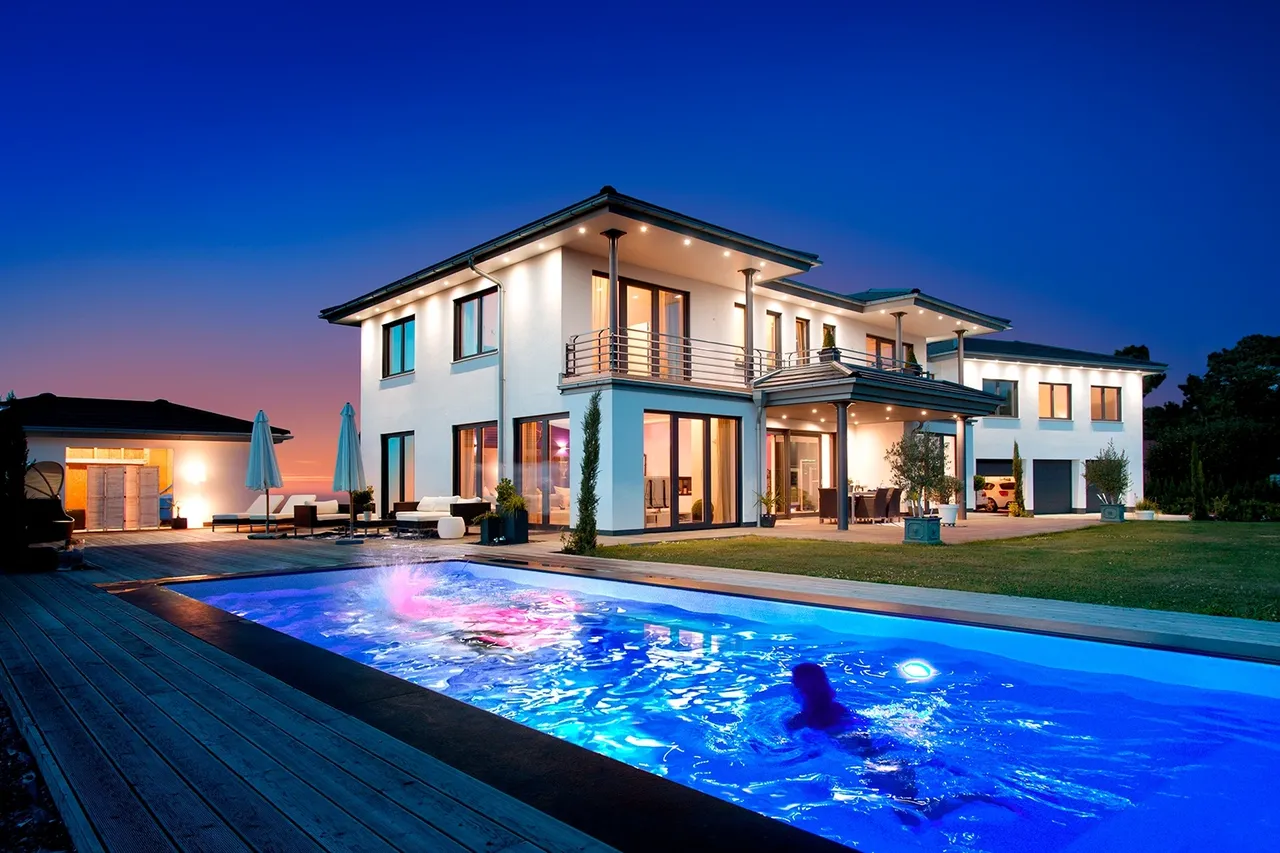
Window Specifications for Luxury Custom Homes
Luxury custom homes demand a fenestration specification built around whole-window performance, not just center-of-glass figures. LuxHaus factory-direct systems from Germany, Italy, and Poland deliver whole-window U-values as low as 0.14–0.18 Btu/h·ft²·F, STC ratings of 42–50+ dB, and triple EPDM seals — making them the baseline choice for Passive House-aligned custom residential work.
Why Windows Luxury Custom Homes Demand a Different Specification Process
Windows luxury custom homes require more than a standard product schedule. When a residence carries a $5M–$20M construction budget, the fenestration strategy touches acoustics, thermal envelope integrity, structural framing coordination, hardware finish programs, and the owner’s lived experience simultaneously. A specification error at schematic design becomes a six-figure problem at closeout. This guide gives working architects a practical framework for specifying high-performance windows and doors in luxury custom residential projects — covering performance tiers, glazing options, frame systems, hardware, and the coordination checkpoints that prevent costly field surprises.
Performance Tiers for Windows in Luxury Custom Homes
Luxury custom homes are increasingly specified to Passive House or near-Passive House performance targets — not purely for energy savings, but because the thermal comfort, condensation resistance, and acoustic attenuation that come with those assemblies align with owner expectations at this price point. A triple-glazed, thermally broken frame system with insulated spacers is no longer a premium upgrade in this segment; it is the baseline.
Understanding NFRC Labels and ENERGY STAR Tiers for Luxury Custom Home Windows
In North America, NFRC labeling is the standard tool for comparing fenestration performance across manufacturers. For luxury custom homes, you should be referencing the NFRC label to confirm that the assembly — not just the center-of-glass — meets the thermal performance required by your IECC climate zone. ENERGY STAR Most Efficient designation is a useful floor, but Passive House suitable or certified glazing systems exceed it by a meaningful margin. Architects specifying windows luxury custom homes in Climate Zones 5–8 (think northern Illinois, Minnesota, Colorado mountain elevations, or Pacific Northwest) should be targeting Passive House suitable assemblies as a default starting point.
Frame Systems: Matching Material to Project Conditions
The frame system determines thermal performance, long-term maintenance burden, finish longevity, and the hardware ecosystem available to the project. For windows in luxury custom homes, three material families dominate the high-performance imported market.
Thermally Broken Aluminum Frames
German-made aluminum tilt-turn and lift-slide systems with multi-chamber thermal breaks are the dominant choice for contemporary and modernist luxury residential work. The sightlines are minimal, the finish program (PVDF powder coat or anodizing in RAL or NCS colors) is extensive, and the systems are dimensionally stable across wide temperature swings — important in glazed curtain conditions and large-format doors. The trade-off is that aluminum frames conduct more heat than timber or uPVC composites, so the thermal break design and insulated spacer selection become critical specification items.
Timber-Aluminum Composite Systems
Italian-crafted timber-aluminum composite systems pair a hardwood interior (oak, larch, or cherry profiles are common) with an aluminum exterior cladding. The result satisfies owners who want the warmth of a natural material inside without the maintenance exposure of exposed exterior timber. These systems are particularly well-suited to mountain homes and lakefront properties where the interior aesthetic leans toward natural materials. Frame depths on these systems tend to be greater, which has implications for reveals in masonry and stone cladding assemblies — coordinate early with the envelope consultant and the masonry subcontractor.
uPVC Multi-Chamber Systems
Polish-manufactured uPVC multi-chamber frame systems offer the best thermal performance per dollar in the high-performance segment. They are well-suited to projects where the owner wants Passive House suitable performance without the cost premium of aluminum or timber-aluminum. The aesthetic is cleaner than legacy vinyl but still reads as a utilitarian material at close inspection — which means they are more appropriate in contemporary projects where profiles are recessed behind cladding, or in secondary structures on large estates, than in exposed classical or transitional detailing.
Glazing Strategy for High-Performance Luxury Homes
Triple glazing is the standard for windows luxury custom homes in Climate Zones 4 and above. The specification decision is in the fill gas (krypton vs. argon), the low-e coating position, and the spacer system. Krypton-filled units allow a narrower overall unit depth for the same thermal performance — relevant when you are working with slim-profile aluminum systems. The low-e coating position (surface 2 vs. surface 3) affects solar heat gain coefficient (SHGC), which should be tuned by orientation: higher SHGC glazing on south-facing elevations in heating-dominated climates (Zones 5–8), lower SHGC on west elevations in mixed or cooling-dominated zones.
- Triple-glazed units with krypton fill: best thermal performance in slim-profile frames; higher cost per unit
- Triple-glazed units with argon fill: cost-effective in wider-profile systems; well-suited to timber-aluminum and uPVC frames
- Laminated inner lite: standard for any glazing above grade where an impact or safety requirement applies; also improves acoustic performance in primary sleeping areas
- Acoustic laminated glass: specify a PVB interlayer with acoustic properties (not standard PVB) in home theaters, urban infill sites, or homes near airports or highways
Operating Hardware and Smart Integration
Hardware specification on windows luxury custom homes is where architects most often underspecify. The operating hardware on a high-performance tilt-turn or lift-slide system is precision-engineered — and it is also the component the owner will touch thousands of times over the life of the building. Specify hardware finish to match the interior metalwork program from the outset, not as a late-stage value-engineering decision.
- Multi-point locking mechanisms are standard on all high-performance casements and tilt-turns; confirm the locking point spacing and force required to operate meets accessibility requirements where applicable (IRC Chapter 11, ADA where relevant)
- Lift-slide and tilt-slide door systems with sashes exceeding 600 lbs require motorized drive hardware; coordinate rough opening framing and floor junction details early
- Smart home integration (KNX, Z-Wave, or proprietary protocols) is available on most German-made and Italian-crafted premium systems; confirm the home automation consultant’s protocol before finalizing the hardware schedule
Coordination With the Thermal Envelope
The fenestration assembly is only as good as its installation interface. On high-performance luxury custom homes, the window system must be treated as part of a continuous air barrier and thermal control layer — not as a product dropped into a rough opening. Specify the following coordination requirements in Division 08 of the project manual:
- Installation buck system and attachment method must be detailed by the envelope consultant and reviewed by the window manufacturer’s technical team prior to permit submission
- Air sealing at the jamb, head, and sill must be specified in coordination with the wall assembly — not left to field judgment
- Thermal bridging at the structural lintel above large glazed openings must be addressed in the structural and envelope consultant scope simultaneously
For architects seeking a structured approach to specification coordination, the Construction Specifications Institute provides frameworks for integrating fenestration performance requirements consistently across Division 08 sections — a useful reference when coordinating multi-disciplinary project teams.
Passive House Suitable Systems for Luxury Residential Projects
Passive House suitable or certified window assemblies are increasingly standard in the luxury residential market — not because every client pursues PHIUS or PHI certification, but because the performance characteristics overlap directly with what high-end residential owners expect: no drafts near glass, no condensation on frames, near-silent operation, and dramatically reduced mechanical system loads. For a deeper look at how these systems perform in new construction, see the LuxHaus guide on windows for Passive House new construction, which covers assembly selection, installation sequencing, and common specification errors in detail.
Specification Format and Submittal Requirements
When writing the specification for windows luxury custom homes, divide the fenestration section clearly: performance requirements (climate zone, NFRC targets, Passive House suitability where applicable), product requirements (frame material, glazing makeup, hardware finish), and execution requirements (installation method, air sealing, testing). Require the contractor to submit NFRC-certified product data for each unit type, not just a manufacturer’s cut sheet. On projects targeting green building certification (LEED, WELL, or Living Building Challenge), the NFRC label is also the source document for energy modeling inputs.
Use Window IQ, LuxHaus’s free specification comparison tool, to calculate the energy savings impact of different glazing configurations for your project’s specific climate zone and orientation — useful when presenting trade-off analysis to an owner who wants to understand why the fenestration budget is where it is.
Common Specification Errors on Luxury Custom Home Projects
These are the errors that generate RFIs, change orders, and owner dissatisfaction on luxury custom home projects that specified windows luxury custom homes without sufficient coordination:
- Specifying frame color as a late decision: custom RAL powder coat colors have a 6–12 week lead time on German-made and Italian-crafted systems; locking the color at permit set is not optional
- Underspecifying sill and threshold conditions: flush interior sill conditions on lift-slide doors require early coordination with the flooring subcontractor and a structural engineer’s review of the bearing condition
- Treating the glazing unit as separable from the frame spec: on Passive House suitable systems, the glazing and frame are engineered as an assembly; substituting the glazing unit from a different supplier voids the system’s performance certification
- Missing acoustic requirements in the program: primary bedrooms, home theaters, and studies in urban or airport-adjacent sites need acoustic laminated glass specified explicitly — it will not be provided as a default on most systems
Procurement Lead Times and Project Scheduling
Windows luxury custom homes sourced from Germany, Italy, or Poland carry lead times that are longer than domestic alternatives and less forgiving of late design decisions. Current market conditions place lead times for standard configurations at 14–20 weeks from approved shop drawings. Custom configurations — non-standard dimensions, specialty glass, custom hardware finishes — add 4–8 weeks. Submit final window and door schedules to LuxHaus no later than design development completion if you are targeting a standard construction timeline.
Specifying Windows Luxury Custom Homes: The Decision Checklist
Before the window schedule is finalized on a luxury custom home project, confirm each of the following is resolved:
- Climate zone confirmed; IECC performance requirements identified; Passive House target established or ruled out
- Frame material selected and coordinated with interior finish program and exterior cladding reveal depth
- Glazing makeup confirmed by orientation (SHGC tuned per elevation)
- Hardware finish specified and cross-referenced with interior metalwork schedule
- Smart home integration protocol confirmed with home automation consultant
- Air barrier and thermal envelope interface detailed and reviewed by envelope consultant
- Lead time confirmed against project schedule; shop drawing submission date established
Windows luxury custom homes represent a disproportionate share of the envelope’s thermal and acoustic performance — and a disproportionate share of the owner’s visual experience of the space. The specification deserves the same rigor as the structural and mechanical systems. Submit your plans to LuxHaus for a performance review and quote.
Frequently Asked Questions
What whole-window thermal performance should architects target for luxury custom homes in Climate Zones 5–8?
Target a whole-window U-value of 0.14–0.18 Btu/h·ft²·F for Passive House-aligned assemblies in northern and mountain climates. ENERGY STAR v7.0 Northern Zone requires U≤0.22, but high-performance European systems from LuxHaus exceed that threshold meaningfully. Center-of-glass Ug values as low as 0.40 W/m²K are achievable with triple-pane IGUs in thermally broken aluminum or timber-aluminum composite frames.
How do triple-pane IGUs compare to double-pane in cost and performance for luxury residential projects?
Triple-pane IGUs — typically 48–66mm in overall unit depth — carry roughly a 7% price delta over double-pane at the glazing level, a modest premium relative to the whole-project budget of a luxury custom home. The performance return includes center-of-glass Ug as low as 0.40 W/m²K, SHGC as low as 0.11, and an IGU service life of 50+ years versus 15–25 years for standard domestic units.
What acoustic performance can be specified for windows in a luxury custom home?
LuxHaus high-performance window systems achieve STC ratings of 42–50+ dB, compared to 26–34 dB typical of standard domestic windows. That gap is meaningful in urban, airport-adjacent, or mountain resort locations where owner comfort expectations are high. Performance is driven by laminated glass lites of differing thickness, wide IGU air-gap spacing, and triple EPDM perimeter seals that eliminate the flanking paths common in single-seal systems.
What hardware and security standards should be written into a luxury custom home window specification?
Specify 5–7 point multi-point locking as a minimum for tilt-turn and lift-slide systems — compared to the 1–2 point locks standard on domestic products. Multi-point engagement distributes sash compression evenly across the triple EPDM seal perimeter, which is critical for both air-infiltration performance and long-term seal integrity. Hardware finish programs in PVDF powder coat or anodizing across RAL and NCS colors allow coordination with the broader interior hardware package.
What is the typical project timeline and coordination process when specifying LuxHaus systems for a luxury custom home?
Plan for a 12–16 week lead time from shop-drawing approval to site delivery. LuxHaus provides a preliminary estimate within about a week of receiving opening schedules and performance targets, and assigns a project manager on-site for every container delivery — with 1–2 weeks of on-site support for projects involving 20 or more openings. NFRC and ENERGY STAR documentation is available on request, and free samples are available to architects during the specification phase.